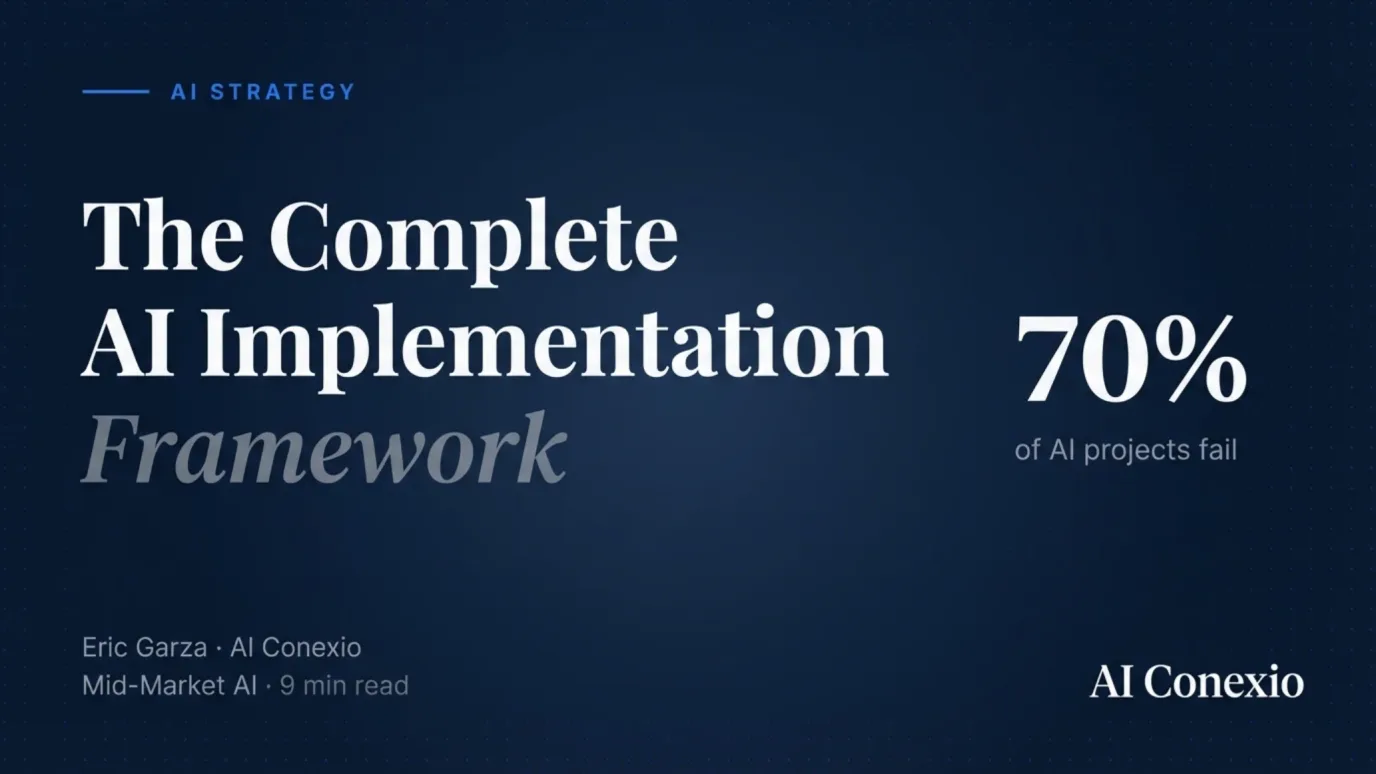
The Complete AI Implementation Framework for Mid-Market Companies
Why 70% of AI projects fail-and how to be in the 30% that succeed. A proven 4-phase framework from assessment to scale, built for mid-market organizations.

Eric Garza
Last quarter, a manufacturing company invested $500K in an AI project that never made it to production. The technology worked. The problem was everything around the technology-no clear use case, no stakeholder alignment, no data foundation. Just a vendor demo that turned into a budget line that turned into a cautionary tale.
This isn't unusual. 70% of AI projects fail to deliver expected business value. The primary reason isn't the technology-it's the absence of a structured approach before the technology is ever selected.
Success in AI implementation isn't about having the best tools. It's about having the right process.
Why AI Projects Fail at Such High Rates
Before prescribing a framework, it's worth understanding the failure modes, because they're remarkably consistent across industries and company sizes.
Technology-first thinking is the most common culprit. Companies start with "We need AI" rather than "We need to solve X problem." The result is a solution searching for a problem-expensive, disorienting, and impossible to measure.
Poor data quality is the second major failure. AI requires clean, structured, accessible data. In practice, about 70% of project time ends up spent on data preparation-time that wasn't budgeted because nobody asked the data question before signing contracts.
Underestimating change management kills even technically successful projects. Technology is only about 30% of what determines success. Employee resistance, unclear ownership, and absent training can make a perfect solution useless. The perfect chatbot that nobody uses is a real phenomenon.
No clear success metrics makes failure inevitable in a different way. "Improve efficiency" isn't a KPI. Without measurable targets established before implementation, there's no way to prove ROI, and no way to defend the next AI budget request.
Inadequate security and compliance planning is an afterthought that becomes a showstopper-especially in regulated industries. Retrofitting security is more expensive than building it in from the start.
The 4-Phase Framework
After working with mid-market organizations across healthcare, financial services, manufacturing, and professional services, we've identified a repeatable framework that consistently produces AI programs that scale past the pilot stage.
Phase 1: Assessment and Strategy (Weeks 1–2)
Purpose: Understand where you are before deciding where to go.
The assessment phase is where most organizations skip ahead-and where most failures are seeded. Two weeks of structured assessment prevents months of misdirected implementation.
Key activities:
- Organizational readiness assessment: Technical infrastructure audit, data maturity evaluation, team skills inventory, cultural readiness
- Use case identification: Business problem prioritization, impact vs. feasibility matrix, ROI potential calculation
- Success metrics definition: Baseline measurements, target KPIs, measurement methodology
Deliverables: AI readiness score, prioritized use case list, ROI projections, risk assessment
A mid-sized healthcare provider spent two weeks in this phase and discovered that their patient scheduling process had 10x the ROI potential of their initial AI idea (diagnostic assistance). That redirection saved them from an expensive mistake and put them on a path to measurable results.
Phase 2: Pilot Selection (Weeks 3–4)
Purpose: Choose the right first project.
Not the most ambitious project. Not the project the loudest executive wants. The right project-the intersection of high impact, low complexity, available data, and stakeholder support.
The pilot project selection criteria:
- High impact: Meaningful time or cost savings, measurable outcome
- Low complexity: Bounded scope, well-understood process, minimal integration debt
- Available data: Clean, accessible, sufficient volume
- Stakeholder support: An executive sponsor and a process owner who both want this to succeed
Select one pilot. Resistance to running multiple pilots simultaneously is one of the most important disciplines of this phase. A financial services company chose invoice processing over their "moonshot" idea of AI-driven investment recommendations. The invoice project succeeded, built organizational credibility, and funded five more AI initiatives over the following year.
Key activities:
- Pilot project selection and scoping
- Team assembly (cross-functional, with executive sponsor)
- Governance establishment (decision rights, review cadence, escalation path)
- Success criteria documentation
Deliverables: Pilot project charter, team roles, project timeline, success criteria
Phase 3: Implementation (Weeks 5–10)
Purpose: Build, deploy, and refine the solution.
This is where the work gets done-but the ratio of effort matters. Invest 70% in change management and people. The technology should take the remaining 30%.
Key activities:
- Solution development or vendor integration
- Training and change management programs
- Iterative testing with direct user involvement
- Weekly sprint reviews with visible metrics dashboard
A retail company deployed their AI recommendation engine in three stores first. User feedback in week one led to twelve UX changes that improved adoption from 40% to 87%. Iterative deployment-not big-bang rollout-is the standard that produces those results.
Critical success factors:
- Weekly sprint reviews
- Direct user involvement from day one
- Metrics dashboard visible to all stakeholders
- Active leadership engagement (not just approval)
Deliverables: Working AI solution, training materials, user documentation, performance baseline
Phase 4: Scale and Optimize (Weeks 11–12+)
Purpose: Expand what works, build internal capability, and fund the next initiative.
Key activities:
- Results documentation: ROI vs. projection, lessons learned, success stories
- Expansion planning: Additional use cases, department rollout, geographic expansion
- Optimization: Performance tuning, cost reduction, feature enhancement
- Capability building: Internal skill development, process documentation, best practices
After a successful pilot, a manufacturing company scaled their quality inspection AI from one production line to twelve lines in six months. ROI improved from 180% at pilot to 340% at scale, as fixed infrastructure costs were amortized across more usage. The scale phase is where the economics of AI become genuinely transformational.
Case Study: 90 Days from Zero to AI-Powered
A 250-person professional services firm came to us with a specific problem: contract review was consuming 40+ hours per contract, introducing delays and errors, and blocking growth.
Weeks 1–2 (Assessment):
- Identified contract review as highest-impact use case
- Discovered 5,000 historical contracts suitable for training
- Defined success: 70% time reduction, 95% accuracy
- Projected ROI: 280%
Weeks 3–4 (Pilot Selection):
- Selected Statement of Work contracts as the pilot type
- Assembled team: Managing Partner (sponsor), Operations Manager (process owner), Technical Lead
- Defined 8-week pilot scope with clear exit criteria
Weeks 5–12 (Implementation):
- Chose private LLM deployment given client data sensitivity
- Trained model on historical SOW contracts
- Integrated with existing document management system
- Iterative testing with three attorneys providing direct feedback weekly
Results at 90 Days:
- 85% time reduction (exceeded 70% goal)
- 96% accuracy (met goal)
- ROI: 340% (exceeded 280% projection)
- Zero security incidents
- Expanded to four additional contract types within six months
The success factors were consistent with the framework: narrow pilot scope, clear metrics, strong executive sponsorship, and continuous user feedback during implementation.
The Five Pitfalls to Avoid
Skipping assessment. Every week spent in assessment saves months of misdirected implementation. Make it mandatory.
Boiling the ocean. One high-impact use case, done well, unlocks organizational confidence and funding for everything that follows. Multiple simultaneous pilots fragment attention and dilute results.
Technology over people. The perfect solution nobody uses is worth exactly zero. Change management isn't a soft discipline-it's the primary determinant of whether the technology delivers value.
No executive sponsor. When obstacles appear-and they will-projects without executive sponsorship die. Secure the sponsor before committing to implementation.
Unclear success metrics. Define measurable KPIs in Phase 1. "Improve efficiency" isn't a metric. "Reduce contract review time from 40 hours to 12 hours" is.
What Phase Is Your Organization In?
The framework is linear, but organizations join it at different points. Some are genuinely pre-assessment-they have AI enthusiasm but no strategy. Others have tried pilots that stalled and need to understand why. A few are scaling and want to systematize what's working.
The assessment is always the right starting point, regardless of where you think you are.
We've compiled everything from this framework-templates, calculators, detailed playbooks for each phase-into our AI Implementation Guide. It's free and doesn't require an email address.
If you'd rather talk through your specific situation, our AI Strategy service is where we do this work together-building the operating model and governance framework before touching any tools.
The 30% that succeed at AI implementation aren't smarter or better resourced than the 70% that don't. They're more deliberate.
Was this article helpful?

About Eric Garza
With a distinguished career spanning over 30 years in technology consulting, Eric Garza is a senior AI strategist at AIConexio. They specialize in helping businesses implement practical AI solutions that drive measurable results.
Eric Garza has a proven track record of success in delivering innovative solutions that enhance operational efficiency and drive growth.