
Executive Summary: The Sovereignty Dilemma
Public frontier LLM APIs offer strong speed-to-market, but they introduce real planning friction: vendor-specific data retention, residency, audit constraints, compliance requirements, and usage-based billing that can scale poorly for high-volume automation.
The thesis: most enterprises do not need to move every AI workload onto private infrastructure. They need a workload-based architecture: run sensitive, high-volume, repeatable tasks on private or dedicated infrastructure, and reserve public frontier models for workflows that require advanced reasoning, multimodal synthesis, or rapid experimentation.
1. The Production Runtime Layer
Ollama is useful for developer sandboxing and small internal deployments. Teams that need lower-level control over GGUF models, quantization, CPU/GPU offload, and local server tuning often use llama.cpp and llama-server as reference runtimes.
For high-concurrency enterprise serving, production stacks usually move toward vLLM, TensorRT-LLM, or managed inference platforms with stronger batching, scheduling, observability, and GPU utilization controls.
Continuous Batching
In-flight request scheduling increases throughput for multi-user workloads.
Paged Attention
KV-cache memory fragmentation is near-eliminated; PagedAttention reduces sequential memory waste to under 4%.
Model Compilation
TensorRT-LLM can materially improve throughput and latency on supported NVIDIA architectures.
2. Model Selection & Quantization Strategy
Standardizing on frontier-class 70B+ models for every task is an architectural anti-pattern that leads to excessive latency and wasted compute. Select models by workload, data sensitivity, latency target, and operational ownership.
Extraction, classification, routing, and first-pass summarization
- Example families: Gemma 4 smaller variants, Qwen3 small/medium instruct models, IBM Granite 4.1 small models
- Why they fit: Lower latency and easier deployment for repeatable tasks
- Deployment caveat: Validate task accuracy before scaling; small models can fail on ambiguous edge cases
Private RAG and internal assistants
- Example families: Mistral Small 3.2 24B, Gemma 4 26B/31B, Llama 4 Scout, Qwen3 variants
- Why they fit: Stronger instruction-following and local/private deployment options
- Deployment caveat: Benchmark retrieval quality, citation behavior, and hallucination rate against your own corpus
Multimodal document and image workflows
- Example families: Gemma 4, Llama 4, Qwen3-VL, Qwen3-Omni
- Why they fit: Useful where PDFs, screenshots, forms, diagrams, audio, or video inputs matter
- Deployment caveat: Confirm OCR, chart, table, and layout performance on real enterprise documents
Coding, tool use, and agentic automation
- Example families: Qwen3-Coder, DeepSeek V4 Flash, NVIDIA Nemotron 3, larger Qwen MoE models
- Why they fit: Better fit for tool-heavy workflows, code generation, and multi-step automation
- Deployment caveat: Require sandboxing, approval gates, and regression tests before granting write access to systems
Quantization Deep-Dive
- AWQ: Strong for GPU-focused production environments where weight compression helps larger models fit into smaller GPU footprints.
- GGUF: Excellent for local sandboxing, edge workstations, and hybrid CPU/GPU testing, but typically bypassed for high-concurrency production serving.
- FP8 / NVFP4: Increasingly relevant for high-throughput GPU serving on supported accelerators, subject to hardware and runtime compatibility.
3. Data Sovereignty & Secure RAG Architecture
RAG is the bridge between static model weights and live enterprise intelligence. In a sovereign blueprint, this bridge should be contained within a hardened perimeter and treated as a governed data product.
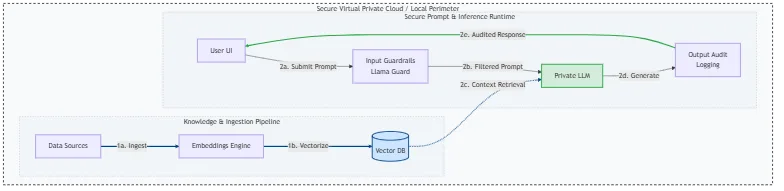
- In-place embedding: source data stays inside the VPC while local embedding models vectorize internal records.
- Vector sovereignty: pgvector or Qdrant can apply standard database controls to the AI knowledge base.
- Local validation: guardrails and safety classifiers should complement allowlists, access checks, and audit logging.
4. Model Context Protocol as the AI Integration Layer
MCP is useful to think of as an Enterprise Service Bus for the AI era: a standardized integration layer that governs how AI systems discover and invoke business capabilities.
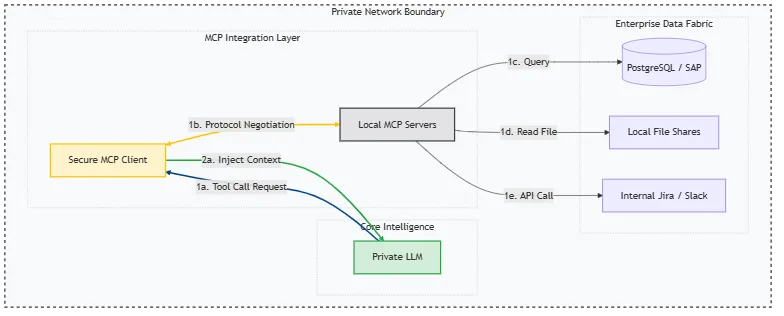
- Secure abstraction: expose narrow tools instead of broad database credentials.
- Least privilege: use scoped service accounts, allowlisted tools, user authorization, approval gates, strict egress policy, and immutable audit logs.
- Contextual fetching: retrieve only relevant rows or file snippets without exposing unrestricted network paths.
5. Financial Architecture: TCO & ROI
Private inference is not just a GPU purchase. It requires platform ownership for uptime, autoscaling, patching, model rollbacks, observability, capacity planning, security reviews, and incident response.
Volume & Performance
- Daily token volume
- Input/output ratio
- Concurrency
- Latency target
Data & Governance
- Sensitivity tier
- Compliance requirements
- Retention and deletion
- Access-control model
Infrastructure & Personnel
- Operating model
- Ops owner
- Engineering support cost
- Target GPU utilization
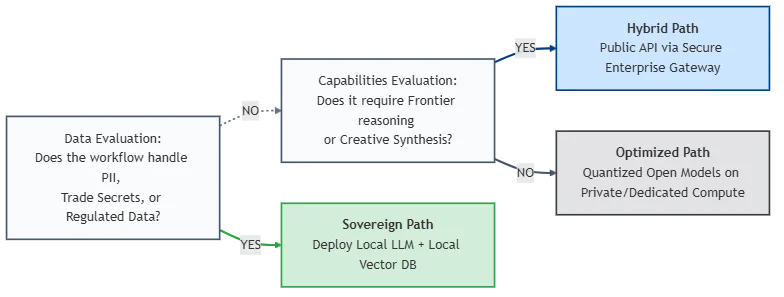
6. The Practical Decision Rule
Use private or hybrid infrastructure when:
- The workflow is high volume and predictable
- Data is sensitive, regulated, or contractually restricted
- Latency matters
- The task benefits from right-sized models
- The outcome justifies operational ownership
Use public frontier APIs when:
- The workflow is low volume or experimental
- Top-tier reasoning is required
- The use case is multimodal or rapidly changing
- Sensitive enterprise data is not involved
- Speed-to-market matters more than infrastructure control
7. Minimum Production Checklist
Identity and Access
Role-based access, scoped service accounts, and user-level authorization for tools and data.
Network Boundary
Private endpoints, restricted egress, secrets management, and explicit trust zones.
Model Governance
Approved registry, license review, version pinning, quantization record, and rollback path.
Evaluation Harness
Task benchmarks, hallucination checks, retrieval quality tests, safety tests, and regression suites.
Observability
Request logs, token usage, latency, GPU utilization, retrieval traces, guardrail events, and audit trails.
Data Controls
Retention policy, encryption, PII handling, access reviews, and deletion workflows.
Reliability
Capacity plan, queueing behavior, fallback path, backup strategy, and incident-response runbook.
Cost Controls
Budget alerts, workload attribution, utilization targets, and reserved-capacity review cadence.
Next Steps: Map Your Sovereign Path
Successful AI adoption requires more than a model; it requires an architectural blueprint that respects the boundaries of enterprise data.
Book an AI Infrastructure Strategy CallRelated Resources
Private LLM Deployment Guide
Implementation guidance for self-hosted LLM infrastructure.
Read GuideLLM Integration Technical Guide
Architecture patterns for integrating LLMs into production systems.
Read GuideAI Governance & Compliance Guide
Controls, policies, and evidence practices for production AI.
Read GuideNeed to Decide Which AI Workloads Belong Where?
AI Conexio helps teams assess data sensitivity, workload economics, model fit, and implementation risk before committing to a platform strategy.