7 Pain Signals That Tell You Where to Start Diagnosing Your AI Program
When an AI program feels off but no one can say why, the instinct is to launch another initiative. The faster move is to read the signals you already have. Here are seven, and the structural gap each one points to.

Eric Garza
7 Pain Signals That Tell You Where to Start Diagnosing Your AI Program
There is a moment in most AI programs when something clearly feels off, but no one can say exactly what. The dashboards are not red. No single project has failed loudly. And yet leadership has the distinct sense that the program is producing motion without producing value.
The common response to that feeling is to launch something new. A new tool, a new pilot, a new initiative to "get AI back on track." It rarely helps, because the problem was never a shortage of activity. The faster, cheaper move is to stop and read the signals already sitting in front of you.
The pain is information. Read it correctly and "something feels off" turns into a specific, fixable list.
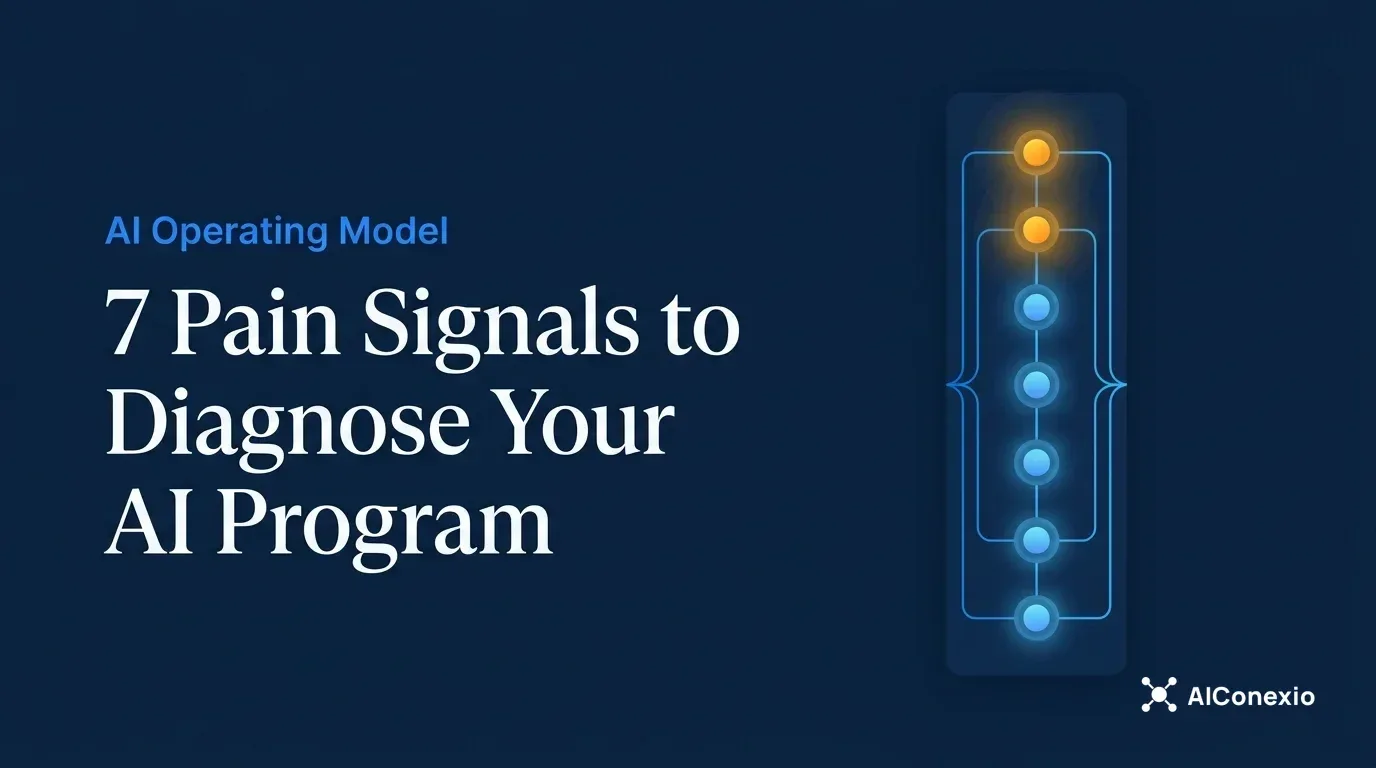
These seven pain signals are the ones we see most often, and each points to a specific structural gap underneath it. You do not need all seven to act. Recognizing even one tells you where the real problem sits and where to start diagnosing.
The seven signals at a glance
Before the detail, here is the whole map. Each signal is a visible symptom. Each one resolves to a structural gap underneath, and the gaps repeat far more than the symptoms suggest.
| # | Pain signal | The gap underneath |
|---|---|---|
| 1 | Lots of AI activity, no agreed way to measure it | Measurement |
| 2 | Teams say AI works, leadership says value is unclear | Translation |
| 3 | One workflow owned by three functions, no one end to end | Ownership |
| 4 | Shadow tools keep appearing in core workflows | Workflow fit |
| 5 | Pilots succeed but never become production | Transfer |
| 6 | Governance exists on paper but not in the workflow | Control |
| 7 | Leaders cannot name which AI effort to stop | Prioritization |
Signal 1: Lots of AI activity, no agreed way to measure it
You have tools deployed, teams experimenting, and pilots running. What you do not have is a shared definition of what counts as a result. Everyone is busy, but no one can say whether the busyness is producing value.
The gap underneath: measurement. You cannot tell value from motion. This is often the first signal to address, because until you can measure outcomes, every other diagnosis stays a guess. The measurement gap is the fog that hides the others.
Signal 2: Every team reports AI is working, leadership says value is unclear
Walk the floor and every team will tell you their AI tools are helping. Sit in the boardroom and leadership cannot point to a business number that moved. Both groups are being honest. They are just measuring different things, activity at the team level, outcomes at the executive level, with nothing connecting the two.
The gap underneath: translation. There is no bridge between activity and outcomes. Teams report effort, leadership needs results, and no shared framework converts one into the other. This is a measurement gap in its most political form, because both sides feel correct and neither can prove it.
Signal 3: One workflow owned by three functions, no one end to end
A core process runs across operations, IT, and a business unit. Each contributes. None owns the outcome. When a decision is needed, when a trade-off has to be made, when the workflow needs a push from pilot to production, there is no single person whose job it is to make the call.
The gap underneath: ownership. This is the gap that quietly stalls scale. Shared contribution is enough to run an experiment but never enough to institutionalize one. Production needs an accountable owner, not a committee.
Signal 4: Shadow tools keep appearing in core workflows
You block one unsanctioned AI tool and another shows up. People keep routing around the approved path no matter how many times you close it off. The workarounds are not random. They cluster around specific steps in specific workflows.
The gap underneath: workflow fit. The approved path is losing to the workaround because it stopped serving the work. Shadow tools are not a discipline problem, they are unfiltered feedback about where your sanctioned workflow is too slow or too brittle to use. Blocking the tool relocates the problem. Fixing the workflow ends it.
Signal 5: Pilots succeed but never become production
Your pilots work. The team likes the tool, the demo lands, the proof of concept proves the concept. Then nothing happens. Six months later the pilot is still a pilot, and the next one starts the same cycle.
The gap underneath: transfer. Nothing carries a successful pilot into the operating model. Usually this is an architecture problem, each pilot was built as a one-off with no standard the next team could reuse, so every success is stranded. Pilot purgatory is not a failure of the experiments. It is the absence of a path from experiment to infrastructure.
Signal 6: Governance exists on paper but not in the workflow
The acceptable-use policy is written. The training was delivered. And yet sensitive data still flows through unsanctioned channels, because following the policy would mean missing the deadline. The control exists in the document and is bypassed in practice.
The gap underneath: control. The policy cannot be followed where the work actually happens. Governance gaps are not closed by writing stronger policies. They are closed by making the compliant path the easy path, so people are not forced to choose between doing their job and following the rules.
Signal 7: Leaders cannot name which AI effort to stop
Ask leadership which AI initiative they would cut first, and the room goes quiet. Everything feels important, so nothing can be deprioritized. The program keeps accumulating efforts and never sheds any, which is how you end up with twenty initiatives and no focus.
The gap underneath: prioritization. When everything is important, nothing is sequenced. The inability to name what to stop is the clearest sign that the program has motion without an order of operations. Until you can rank by leverage, you cannot focus, and without focus the activity keeps multiplying.

How to read your signals
Notice that the seven signals collapse into a handful of recurring structures: measurement, ownership, workflow fit, transfer, control, and prioritization. The symptoms feel distinct, but the gaps underneath repeat. That is the point. You are not facing seven unrelated problems. You are facing a few structural gaps showing up in different costumes.
So the diagnostic move is straightforward:
- Mark the signals you recognize. Honestly, not aspirationally. Two or three is typical.
- Name the gap under each. Use the table above to translate symptom into structure.
- Find the gap that repeats or blocks the most. That is where you start.
In our experience, measurement gaps are often the right first target, because clearing the fog makes every other gap visible. Ownership gaps come next, because nothing else gets fixed without someone accountable for fixing it. The remaining gaps tend to resolve faster once you can both see your outcomes and name who owns them.
You do not need a new initiative to find where your AI program is struggling. You need to read the signals you already have. Treated that way, "something feels off" turns into a specific, fixable list, and the program stops being a source of vague unease and becomes something you can actually manage.
Recognize a few of these signals but not sure which to tackle first? A Workflow Integration Discovery Session reads your pain signals, names the structural gaps underneath, and hands you a sequenced plan for where to start.
Was this article helpful?

About Eric Garza
With a distinguished career spanning over 30 years in technology consulting, Eric Garza is a senior AI strategist at AIConexio. They specialize in helping businesses implement practical AI solutions that drive measurable results.
Eric Garza has a proven track record of success in delivering innovative solutions that enhance operational efficiency and drive growth.