Why the Loudest AI Complaint Is Rarely the One to Fix First
The AI complaint that gets airtime is the one attached to the most senior frustrated person, not the one attached to the most customer value. Volume and leverage are different signals. Good diagnosis separates them before anyone picks a fix.

Eric Garza
Why the Loudest AI Complaint Is Rarely the One to Fix First
Walk into any leadership meeting where AI is on the agenda and you will hear about a problem. Usually one problem, loudly. A senior leader is frustrated that the new AI tool keeps producing the wrong output, or that a workflow they touch every day still feels clunky, or that a pilot they sponsored has not delivered. The room orients around that complaint, and within a week, resources are pointed at fixing it.
Here is the uncomfortable part. The loudest AI complaint in the room is usually not the one worth fixing first.
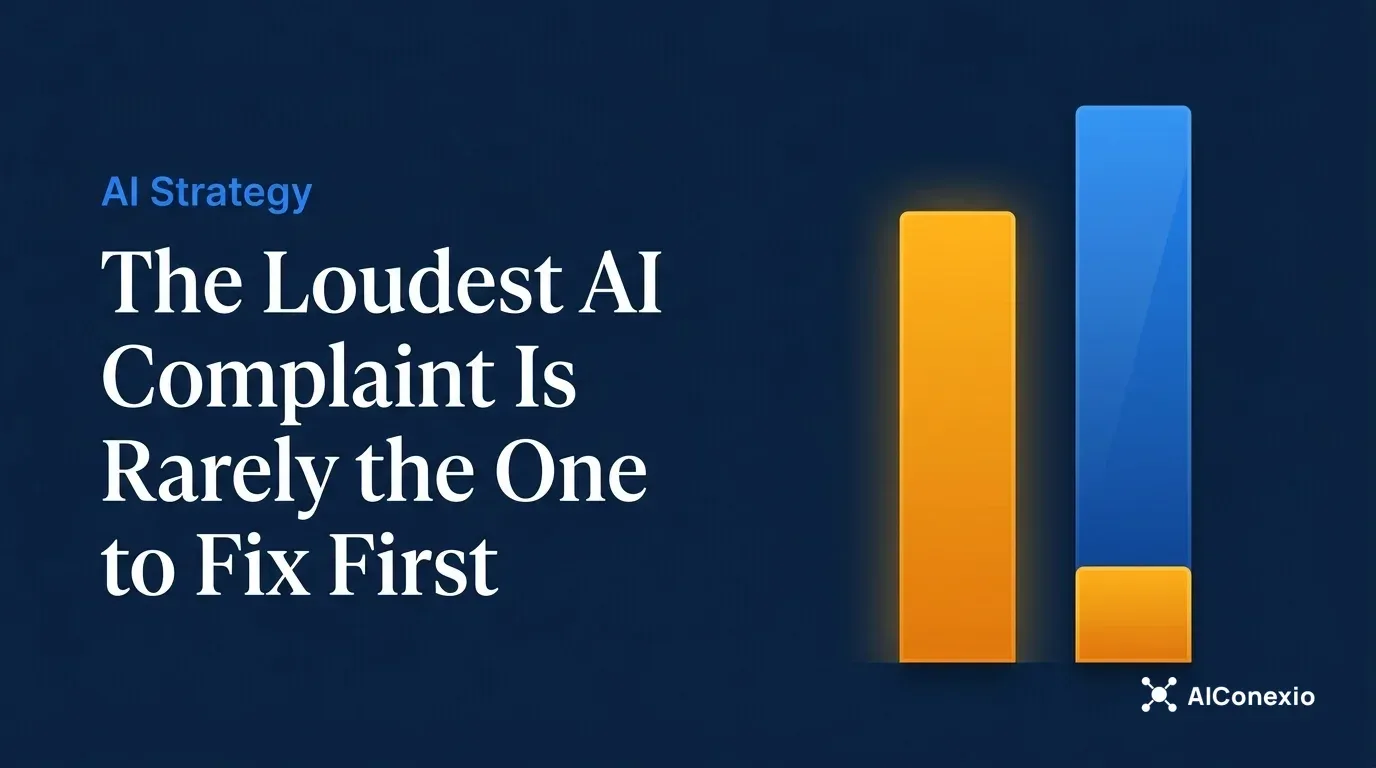
The complaint that gets airtime is the one attached to the most senior frustrated person, not the one attached to the most customer value.
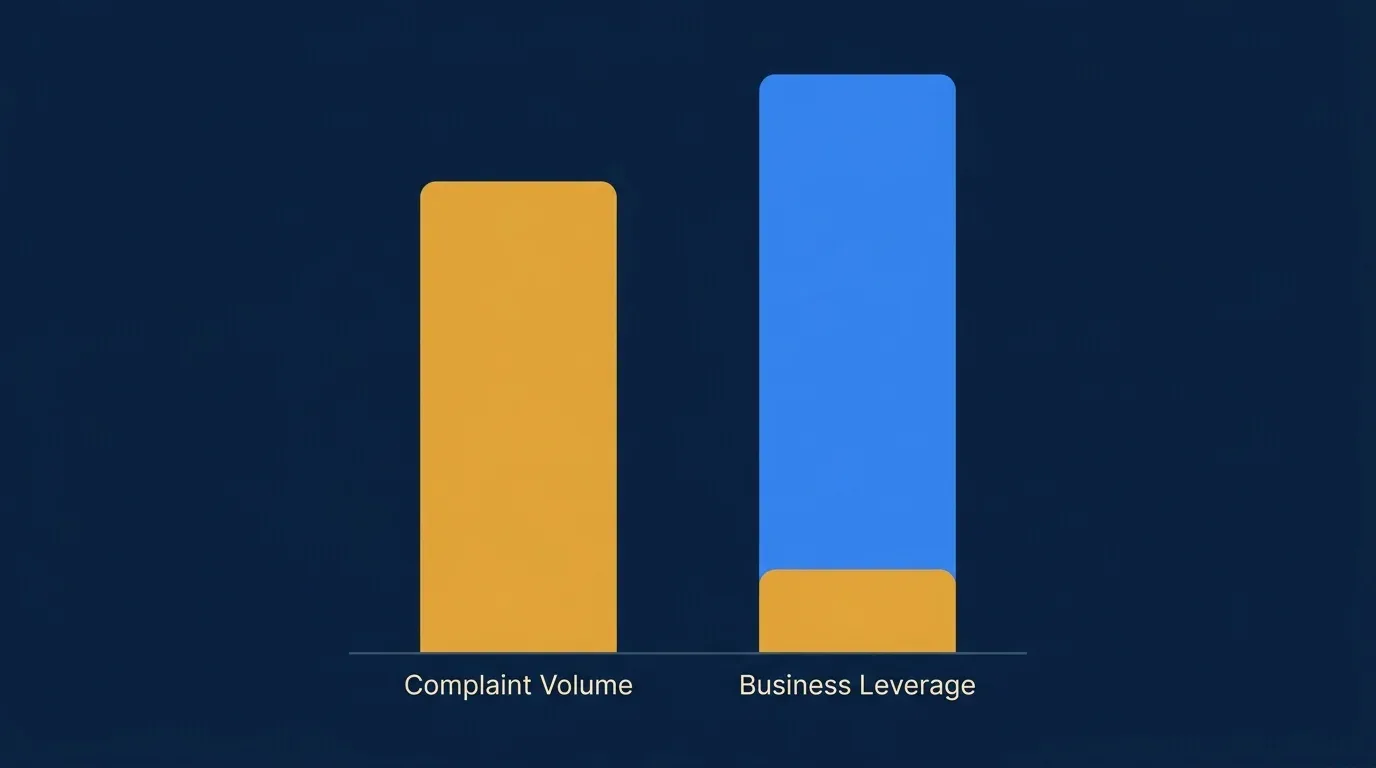
This is not a knock on the person complaining. It is a structural feature of how organizations surface problems. Volume of complaint and size of leverage are two completely different signals, and they get confused constantly. When you fix by volume, you pour effort into the noisy workflow while the high-leverage one stays quietly broken.
Why the loud complaint wins the room
Complaints do not reach leadership in proportion to their business impact. They reach leadership in proportion to the seniority and visibility of the person feeling the pain. That creates a predictable distortion.
A frustrated executive has a direct channel to the decision. They raise it in the meeting, it gets airtime, and the organization mobilizes. Meanwhile, a far more valuable problem sits two levels down in a team that has quietly absorbed the friction for months. They built a workaround. They stopped complaining because complaining never changed anything. So the problem with real leverage goes silent, precisely because the people closest to it adapted.
The result is an attention market that rewards proximity to power over proximity to value. The loud complaint is not lying about being painful. It is simply not the same thing as being important. And because it arrives with urgency and a senior name attached, it feels like the obvious priority when it is often just the obvious noise.
The cost of fixing by volume
When a program consistently fixes the loudest problem, three things happen, and all of them compound.
First, effort flows to the noisy workflow regardless of its leverage. Engineering time, leadership attention, and budget get spent improving something that was never going to move a business number much.
Second, the high-leverage problem stays broken. Nobody is escalating it, so nobody is funding it. The team living with it keeps routing around it, and the value that a fix would unlock never materializes.
Third, the organization learns the wrong lesson. It concludes that volume is the right prioritization signal, so the next cycle repeats with a different loud complaint. Over time, the program optimizes for quieting executives rather than creating value.
| The loud complaint | The high-leverage problem | |
|---|---|---|
| Who raises it | Senior, visible, frustrated | Junior team that already adapted |
| How it arrives | Urgently, in the meeting | Quietly, or not at all |
| Why it feels urgent | Attached to a powerful name | Attached to a business outcome |
| Typical business impact | Often modest | Often large |
| What usually happens | Gets funded first | Stays broken |
None of this means the loud complaint is fake or that you should ignore it. It means you cannot let volume decide the order of work. The fix is not to dismiss the loud problem. It is to rank every AI problem by business leverage first, then decide where the loud one actually sits on that list.
How to rank by leverage instead of volume
Leverage is not a vibe. It is estimable, even roughly, and a rough estimate beats letting the loudest voice decide. For each AI problem on your list, score it on three questions.
- Value at stake. If this were fully fixed, what business outcome moves, and by how much? Revenue, cost, risk, cycle time, retention. Put a number on it, even a rough one.
- Reach. How many transactions, customers, or hours per week flow through this workflow? A small improvement on a high-volume process usually beats a large improvement on a rare one.
- Unlock. Does fixing this make other things possible? Some problems are leverage multipliers, because solving them removes a blocker for several downstream initiatives.
Score each problem on those three, and a different ranking appears than the one the meeting produced. The loud complaint usually lands somewhere in the middle, real but not top. The quiet high-volume workflow that nobody escalated often jumps to the top.
Rank AI problems by business leverage, not by how loudly they are raised. The two lists are rarely the same.
There is a useful discipline here borrowed from triage. In an emergency room, the patient shouting the loudest is not automatically seen first. A trained nurse assesses severity against a consistent scale, because the quietest patient can be the most critical. Prioritization by leverage is the same move applied to your AI program: a consistent scale, applied before anyone decides, so the loudest voice does not set the order by default.

Separating the two signals
The core skill is keeping volume and leverage as separate readings instead of letting one stand in for the other. Both are real information. Volume tells you where the political pressure is. Leverage tells you where the value is. A good operator reads both and treats them as different inputs to the same decision.
Practically, that means doing two things at once. Address the loud complaint enough to maintain trust and keep the senior stakeholder engaged, because ignoring it entirely has its own cost. But put the bulk of your resources behind the high-leverage problem, the one the ranking surfaced, even though nobody is shouting about it. The loud complaint gets managed. The leverage gets funded.
This is also where measurement and ownership quietly matter. If you cannot measure outcomes, you cannot estimate leverage, so volume wins by default because it is the only signal you can feel. And if no one owns the ranking, the meeting reverts to whoever speaks last and loudest. A leverage ranking only holds if someone is accountable for maintaining it and willing to defend a quiet problem against a loud one.
What to do this week
Take the AI problem your leadership team is currently most fired up about. Before funding the fix, do one thing: write down three other AI problems you know exist but that nobody is currently escalating. Score all four on value at stake, reach, and unlock.
If the loud one still ranks first, fund it with confidence. You now know it is genuinely the priority, not just the noisiest. But if one of the quiet three outranks it, you have just caught your program in the act of optimizing for volume, and you have a chance to redirect before the budget is committed.
The loudest complaint is a signal worth hearing. It is just not the signal that should decide where the work goes. Rank by leverage, separate the two readings, and the high-value problem stops losing to the high-volume voice.
Want help ranking your AI problems by real business leverage before you commit resources? A Workflow Integration Discovery Session separates the loud problems from the high-leverage ones and gives you a defensible order of work.
Was this article helpful?

About Eric Garza
With a distinguished career spanning over 30 years in technology consulting, Eric Garza is a senior AI strategist at AIConexio. They specialize in helping businesses implement practical AI solutions that drive measurable results.
Eric Garza has a proven track record of success in delivering innovative solutions that enhance operational efficiency and drive growth.