Shadow AI Is a Workflow Problem, Not a Policy Problem
Teams do not route around approved AI tools because they hate policy. They do it because the workflow stopped serving the work. Treat shadow AI as a fit symptom and the workaround becomes a map to the friction your process never solved.

Eric Garza
Shadow AI Is a Workflow Problem, Not a Policy Problem
When a leader discovers that someone on their team has been pasting customer data into a personal AI account, the reflex is immediate and predictable: write a policy, block the tool, send the reminder about acceptable use. The problem gets filed under risk and discipline, and the matter is considered closed.
It is not closed. In most organizations, it is barely understood.
Shadow AI, the unsanctioned use of AI tools inside everyday work, is real and it is a genuine risk. But the dominant way leaders frame it, as a discipline failure to be corrected with policy, gets the diagnosis backward. People do not reach for unofficial AI because they enjoy breaking rules. They reach for it because the approved workflow stopped serving the work, and the workaround does the job faster or cleaner than the sanctioned path.
Shadow AI is a fit symptom, not a discipline failure. The detour is a map to the friction your approved process never solved.
If that reframe is correct, and in our experience it almost always is, then the standard response makes the problem worse. You cannot fix a workflow problem with a policy. You can only push it somewhere you can no longer see it.

The reflex that fails
The conventional shadow AI playbook treats the tool as the problem. Identify the unsanctioned app, block it, issue guidance, audit for repeat offenders. This is governance theater: it looks like control on a slide and behaves like a blind spot in practice.
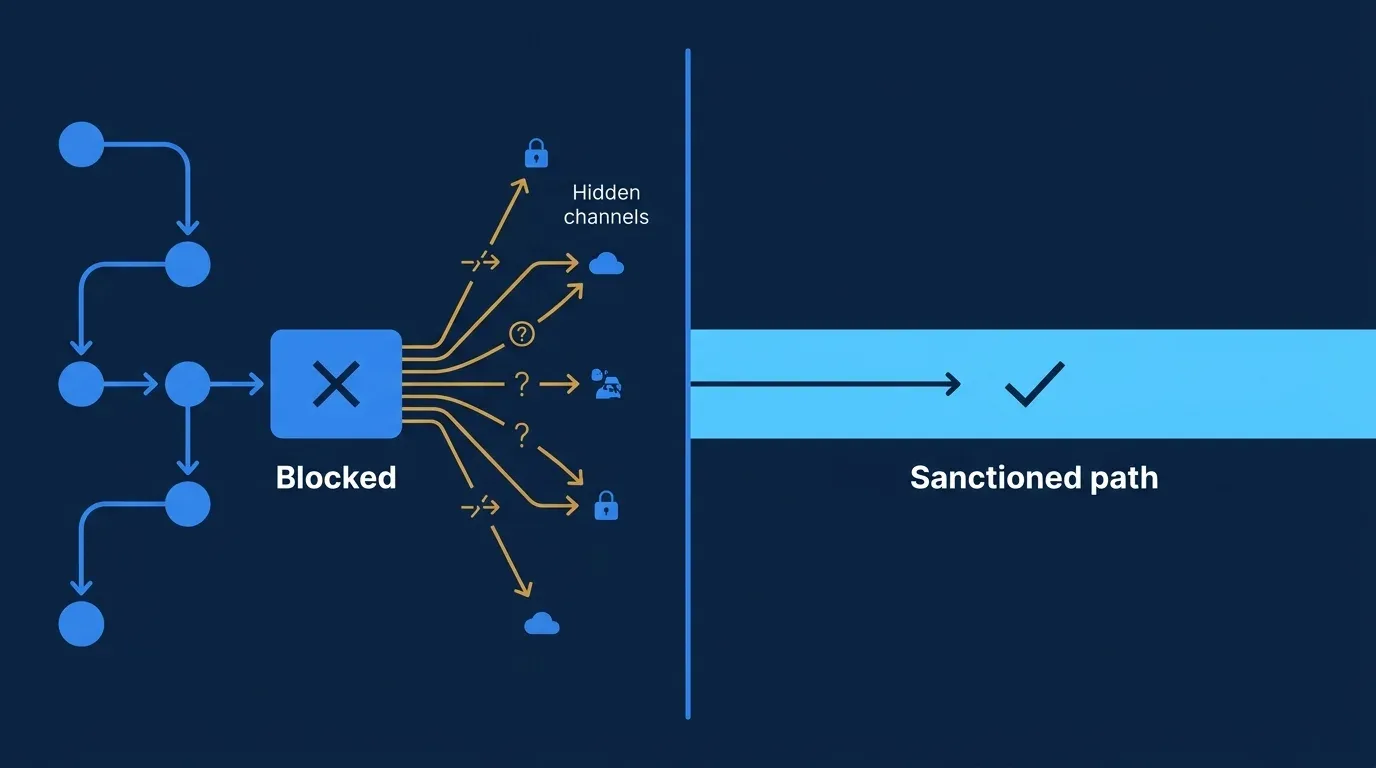
Here is why it fails. Block the app and the work does not stop. The deadline is still there. The pressure is still there. The person still needs the answer. So the work migrates. It moves to personal devices, home accounts, and tools with no logging at all. You did not eliminate the risk. You relocated it, and you traded a visible, fixable problem for an invisible one.
The data still leaves. The prompts still get pasted. The sensitive context still flows out of your control. The only thing that changed is your ability to see it happening.
Consider a real and common pattern. A claims team is told to stop using a popular AI assistant because it is not approved. The volume of claims does not drop. The service-level targets do not move. So within a week, two analysts are doing the same work on their phones, on personal accounts, over the cell network, where IT has no visibility, no logging, and no ability to scope what data was exposed. The ban did not reduce the risk. It blinded the people responsible for managing it.
| Ban the tool | Fix the workflow | |
|---|---|---|
| What happens to the work | Migrates to invisible channels | Stays on a path you can see |
| Effect on risk | Relocated, not removed | Reduced at the source |
| Effect on visibility | Lost | Preserved or improved |
| Durability | Temporary, spawns the next workaround | Durable, removes the reason to route around |
| What it signals to staff | "Leadership does not understand the work" | "Leadership fixed the friction" |
Enforcement on its own does not remove shadow AI. It moves shadow AI underground.
What the workaround is actually telling you
Reframe the same event. A team member pastes sensitive data into a side tool. Read that not as "they ignore the rules" but as "the rules made the work harder than the workaround." The unofficial tool is not rebellion. It is doing a job the approved workflow will not, and the person reaching for it is telling you exactly where the sanctioned path stopped serving them.
That gap, between the process on paper and the work in practice, is the real thing to fix.
This is why the workaround is one of the most valuable diagnostic signals a leadership team has. It is unfiltered, unprompted feedback about where your operating model is brittle. Nobody filled out a survey. Nobody escalated. Someone simply found the slow step painful enough to route around it, quietly, on their own time. That is worth more than most formal process reviews, because it is revealed behavior under real deadline pressure, not stated opinion in a meeting.
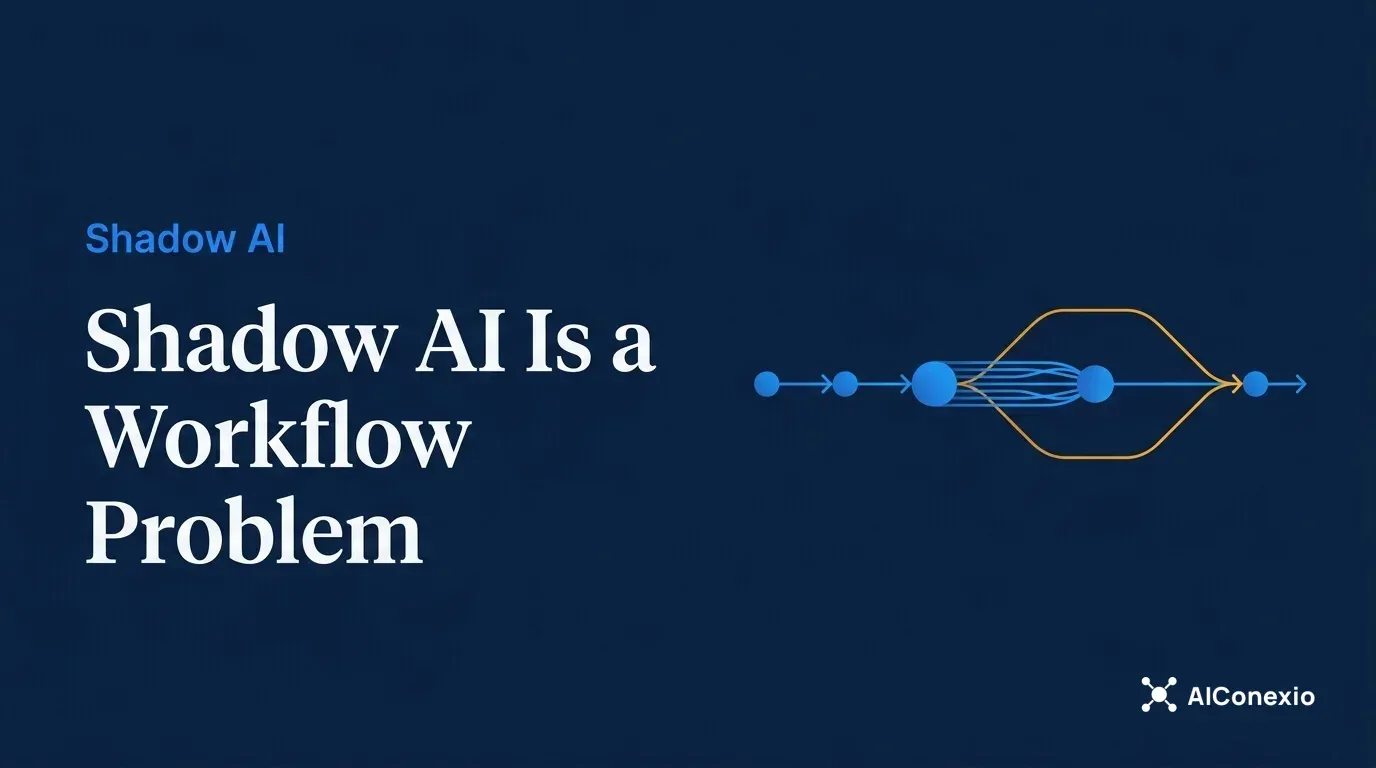
There is a useful analogy from urban design. When a park is built, planners lay down paved walkways where they think people should go. Then people walk where they actually need to go, and over time they wear dirt tracks across the grass. Those tracks are called desire paths. The wise response is not to fence off the grass. It is to pave the path people already chose. Shadow AI is a desire path. The workaround shows you where the work wants to flow.
How shadow AI actually forms
Unsanctioned AI use does not appear all at once. It forms in three phases, and understanding the sequence is what lets you intervene before the risk compounds.
Phase 1: The friction
The approved workflow is slow, unclear, or brittle at one specific step. People feel it every day, but it never shows up in a status report. The work still gets done, so on paper everything looks fine. This is the critical, invisible stage. The friction is real and it is costing time, but because the output still ships, no metric captures it and no one raises it.
Phase 2: The workaround
Someone quietly routes around that step with an unofficial tool. It works. Then it spreads, not through any rollout, but to the people sitting closest to the same pain. No memo, no project, just one person solving a problem and the desk next to them copying it. By the time the workaround is common, it has already become load-bearing. Real work depends on it.
Phase 3: The blind spot
Eventually leadership notices the unsanctioned tool and reads it as a risk problem. The conversation becomes about the tool, the data, the policy. The original friction, the thing that started all of it, stays invisible. So the team writes a ban, the tool goes underground, and the slow step is still there, waiting to spawn the next workaround.
Notice what happens across these phases. The problem is born in Phase 1 and never addressed. By Phase 3, everyone is arguing about the symptom while the cause sits untouched. Ban the tool and you reset to Phase 1 with a different app. The cycle does not break until someone goes back to the friction that started it.
Six questions to ask before you write the policy
When you suspect shadow AI in a core workflow, resist the reflex to draft guidance first. Run these six questions instead. They move the conversation from "who broke the rules" to "what is the work telling us."
- Which approved workflow is slow or unclear enough that people would want to route around it? Start from the friction, not the tool.
- Where is sensitive data actually flowing, and through which unsanctioned tools? Map the real path, not the policy path.
- What job is the shadow tool doing that the approved path will not? This names the capability gap precisely.
- Who owns the workflow the workaround is attached to? Friction without an owner never gets fixed.
- What would the approved path need to do to win the work back? Define the bar the sanctioned option has to clear.
- Is this a policy gap, or a workflow design gap wearing a policy costume? This is the whole game.
Treat shadow AI as a policy problem and the bans keep failing. Treat it as a workflow problem and the workaround tells you exactly what to fix.
That last question is the one most organizations never ask. Most shadow AI is a workflow-fit problem dressed up as a policy problem.
The real fix is a better option, not a stronger ban
If banning relocates risk, what actually works? Give the work a sanctioned path that is genuinely better than the workaround, so the easy choice and the safe choice become the same choice.
This is a higher bar than most policies aim for, and it should be. The approved option does not just have to exist. It has to win. If the sanctioned path is slower, more bureaucratic, or worse at the actual task than the side door, people will keep using the side door no matter what the policy says. When the approved path is faster than the workaround, the workaround stops getting used on its own. No enforcement required, because there is nothing left to enforce against.
For most teams, winning the work back means redesigning the friction-causing step: simplifying an approval path, integrating a tool people already wanted, or removing a handoff that never needed to exist.
For governance-bound teams, those in regulated industries, those handling data that legally cannot leave the building, it often means something more specific: a private, on-premises AI option that people are actually allowed to use. When the sanctioned tool is both compliant and genuinely good, the trade-off between safe and fast disappears. The analyst who was working on a personal phone now has an approved tool that is faster than the phone ever was, sitting inside the network, with the logging and data residency the organization can actually prove. That is the only durable way to end shadow AI, because it removes the reason the workaround existed in the first place.
What to do this week
You do not need a new policy. You need to find the workflow people are routing around.
Pick the most recent instance of unsanctioned AI use you are aware of. Instead of asking who did it, trace it backward using a simple template:
- The step: What part of the approved workflow were they trying to get past?
- The age: How long has that step been painful, honestly?
- The owner: Who is accountable for that step end to end?
- The bar: What would the approved path have to do to be the obvious choice?
That single trace, done honestly, will teach you more about your operating model than another acceptable-use memo ever will.
Every workaround points at a workflow step that stopped serving the work. Fix that step and the shadow tool loses its reason to exist. Keep banning tools and you will spend the next two years playing whack-a-mole with symptoms while the cause quietly spawns the next one.
Shadow AI is not a story about discipline. It is a story about fit. Read it that way and your biggest governance headache turns into your clearest map of where to improve.
Trying to locate where shadow AI is forming in your organization, or whether a sanctioned private AI option is the right answer? Book a strategy call and we will walk through how we trace a workaround back to the workflow that caused it.
Was this article helpful?

About Eric Garza
With a distinguished career spanning over 30 years in technology consulting, Eric Garza is a senior AI strategist at AIConexio. They specialize in helping businesses implement practical AI solutions that drive measurable results.
Eric Garza has a proven track record of success in delivering innovative solutions that enhance operational efficiency and drive growth.