The Five Structural Categories of Every AI Problem
If every AI problem in your organization sounds unique, your diagnosis is still too shallow. Go one level down and the same five structures keep reappearing. Naming the category is what turns chaos into a plan.

Eric Garza
The Five Structural Categories of Every AI Problem
A pattern shows up in nearly every conversation we have with mid-market leadership teams. They describe their AI problems, and every one sounds completely unique. This team has a data issue. That tool is underperforming. This dataset is messy. That deadline got missed. Each problem feels bespoke, so each gets treated as a separate fire, and leadership ends up firefighting indefinitely.
Here is the thing about that feeling of uniqueness. It is a sign the diagnosis has not gone deep enough yet.
When everything looks unique, you are still describing symptoms. When patterns appear, you have finally reached the diagnosis.
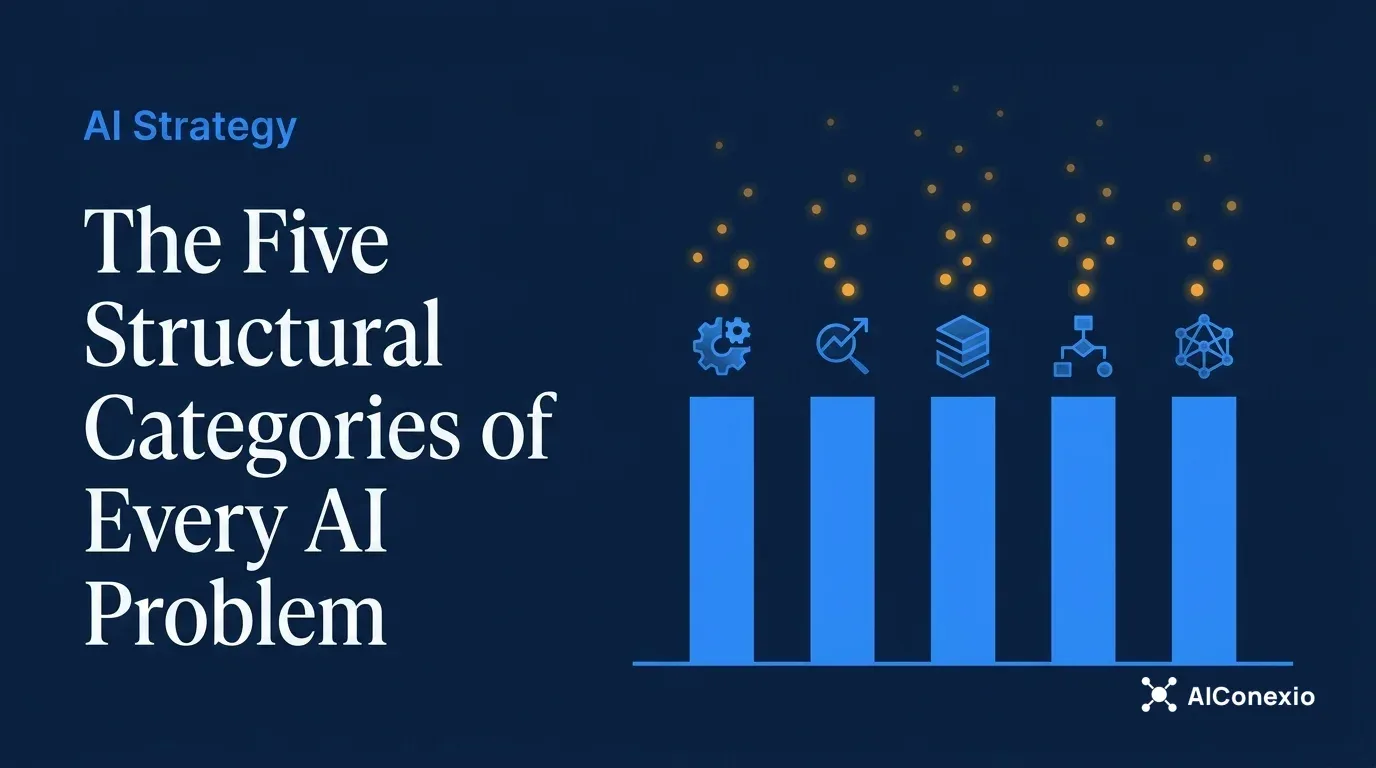
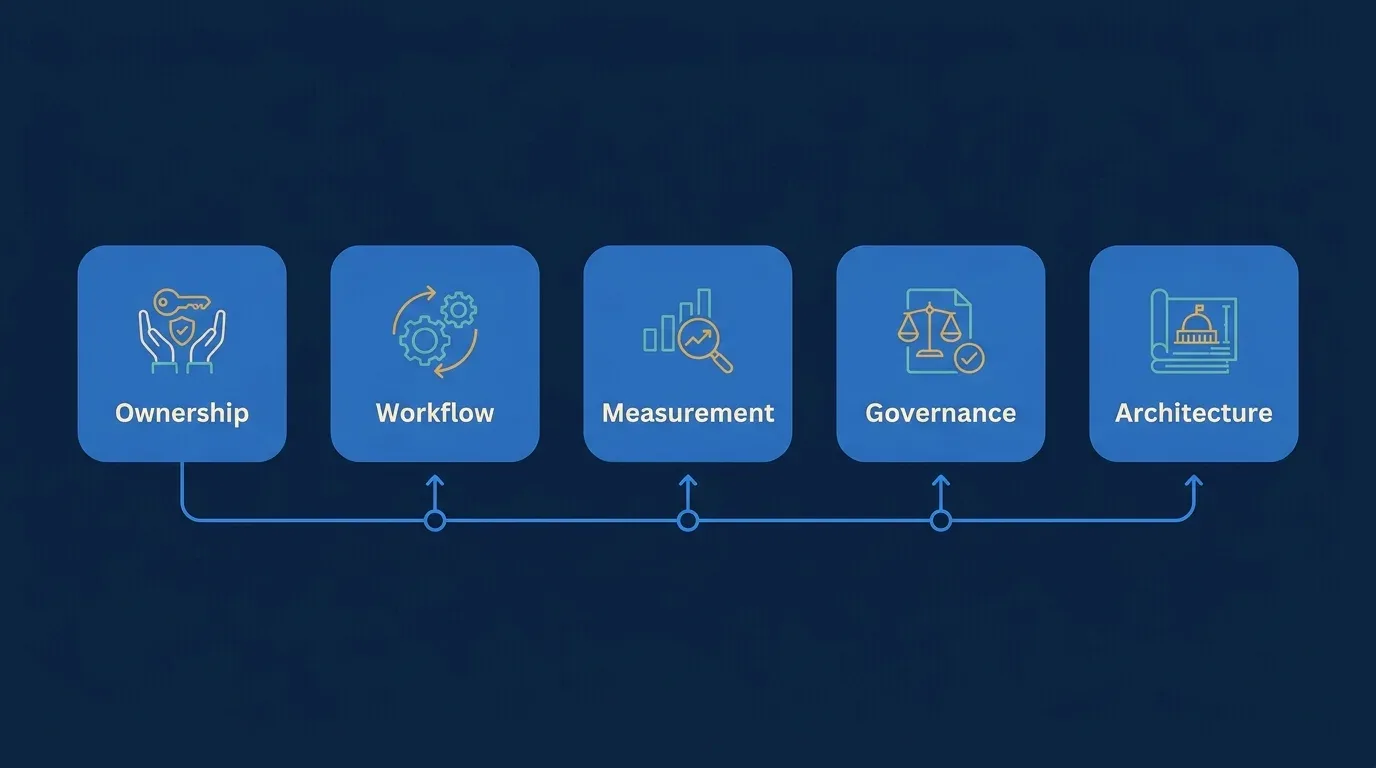
Surface symptoms always sound specific, because they are described in the language of the team, the tool, and the moment. But go one level below the symptom and the same few structures keep reappearing. Most "unique" AI problems collapse into five structural categories: ownership, workflow design, measurement, governance, and architecture.
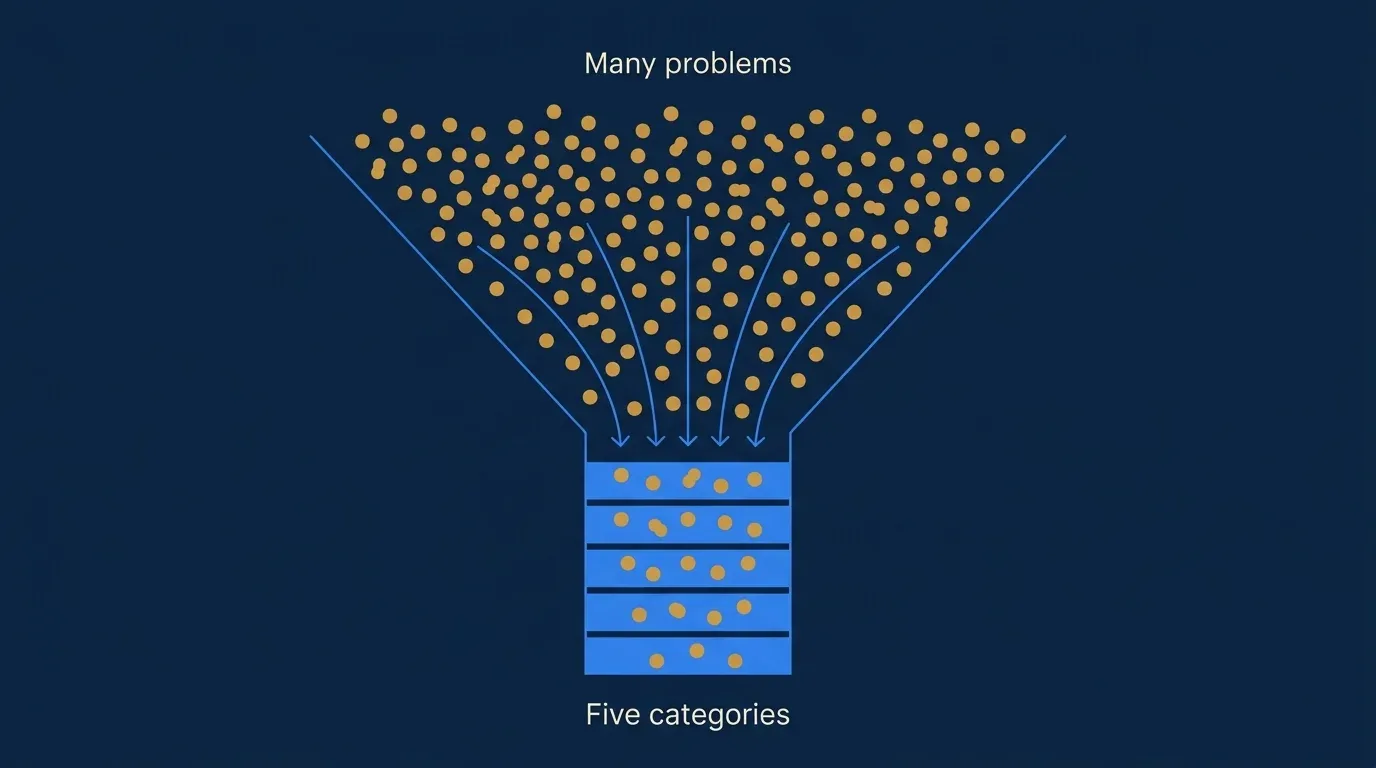
This matters because structural problems are solvable in a way that an endless list of one-off fires is not. You cannot manage forty distinct problems. You can manage five categories. Naming the category is what turns "everything feels chaotic" into a short, sequenced list of things you can actually fix.
Why "unique" is a diagnostic trap
When every problem looks like a one-off, leaders respond the only way one-offs allow: case by case. Each issue gets its own meeting, its own owner, its own patch. The work feels productive because something is always being addressed. But nothing compounds, because no fix transfers to the next problem. You solve the same underlying flaw five times in five disguises and never notice it was one flaw.
The trap is that surface-level description rewards the wrong instinct. The more carefully you document each problem in its own terms, the more unique they seem, and the further you drift from the structure underneath. Good diagnosis runs the opposite direction. It asks, across all of these problems, which structures keep failing? That question collapses the list and reveals the leverage.
Here is the quick reference. Every category has a recognizable signature, a one-line description of the gap underneath, and a fix that lives somewhere specific.
| Category | Signature symptom | The gap underneath | Where the fix lives |
|---|---|---|---|
| Ownership | One workflow, three functions, no end-to-end owner | Decisions stall because no one is accountable | Org design and accountability |
| Workflow design | Tool works, no business number moves | Process around the AI absorbs all the gains | Process redesign |
| Measurement | Lots of activity, no agreed way to score it | You cannot tell value from motion | A shared outcome metric |
| Governance | Policy on paper, bypassed in practice | Control cannot be followed where work happens | Compliant-path-as-easy-path design |
| Architecture | Pilots succeed but never reach production | No reusable standard to carry success forward | Platform and integration standards |
The five categories
1. Ownership
The ownership category covers every problem that traces back to a missing or unclear owner. The classic signature: one workflow touched by three functions, with no single person accountable for the outcome end to end. Everyone contributes, no one owns.
Ownership gaps are insidious because the work still happens. Contributors do their parts. But when something needs a decision, a trade-off, or a push to production, there is no one whose job it is to make the call. This is why ownership gaps are the quiet killers of scale. A pilot can succeed with shared enthusiasm. A production capability needs someone accountable for it on a Tuesday when it breaks.
You are looking at an ownership gap when: initiatives stall whenever a cross-functional decision is required, or efforts that everyone supports somehow never get driven to completion.
2. Workflow design
The workflow design category covers problems where the issue is not the AI but the process the AI was dropped into. The signature here is the shadow tool: unsanctioned AI keeps appearing in a core workflow because the approved path lost to the workaround. It is also the automated task that never moved a business number, because the underlying workflow was never redesigned to take advantage of the new capability.
Workflow design problems get misread constantly. A team adds an AI tool, the metric does not move, and the conclusion is "the AI did not work." Usually the AI worked fine and the workflow around it absorbed all the gains. The handoffs, the approvals, the manual steps before and after, none of it changed, so the leverage leaked out before it reached an outcome.
You are looking at a workflow design gap when: tools technically function but produce no measurable change, or workarounds keep reappearing no matter how many times you block them.
3. Measurement
The measurement category covers problems where you cannot tell value from motion. The signature: lots of AI activity, no agreed way to measure it. Or the version that shows up in the boardroom, every team reports AI is working, leadership says the value is unclear. Both are the same gap. Activity is being produced, but there is no shared definition of what counts as a result.
Measurement gaps are dangerous precisely because they hide every other gap. If you cannot measure outcomes, you cannot tell which initiatives are working, which owners are effective, or which workflows are leaking value.
The measurement gap is the fog that keeps the other four categories invisible. It is often the first one to fix, because clearing it lets you see everything else.
You are looking at a measurement gap when: your team can list twenty AI initiatives but cannot name which one moved a business number.
4. Governance
The governance category covers problems where control exists on paper but not in the workflow. The signature: a policy that cannot be followed where the work actually happens. The acceptable-use document is written, the training was delivered, and yet sensitive data still flows through unsanctioned channels because the approved path is too slow or too unclear to follow under real deadlines.
Governance gaps are not solved by writing better policies. They are solved by making the compliant path the easy path. A control that requires people to choose between doing their job and following the rules will lose every time the pressure is high enough. Effective governance is designed into the workflow, not bolted on after it.
You are looking at a governance gap when: policies are technically in place but routinely bypassed in practice. The fix lives in workflow design as much as in policy.
5. Architecture
The architecture category covers problems rooted in how your AI capability is built and connected. The signature: pilots that succeed but never become production, because each was built as a one-off with no standard the next team could reuse. It also covers the proliferation of disconnected tools, multiple departments paying for redundant capabilities that do not share data or infrastructure.
Architecture gaps show up late and cost the most. Early on, a one-off pilot is the fastest way to prove value, so teams build them. But every one-off is a future integration problem, and a portfolio of them becomes an operating model that cannot scale. The transfer gap, where nothing carries a successful pilot into the production environment, is almost always an architecture gap in disguise.
You are looking at an architecture gap when: experiments work but never institutionalize, or a growing pile of tools does not talk to each other.
How to use the five categories
The point of the framework is not to file problems neatly. It is to change what you do next. Three moves follow directly from it.
First, recategorize before you act. Take your current list of AI problems, however long it is, and sort each one into a category. The list will collapse. Forty problems become a handful of structural gaps, each appearing several times. That collapse is the diagnosis. It tells you where the real work is concentrated, instead of spreading your attention across symptoms.
Second, sequence by leverage, not by volume. Once problems are grouped, you can see which category is generating the most pain and which is generating the most value if fixed. Those are rarely the same. The loudest category is usually the one attached to the most senior frustrated person. The highest-leverage category is the one quietly blocking scale. Measurement gaps in particular tend to be high-leverage, because fixing them makes every other category visible. Rank by leverage, then decide where the loud problems actually sit.
Third, assign an owner per category. Each structural gap needs someone accountable for closing it. This is not the same as assigning someone to each symptom. It is assigning someone to the underlying structure, so the fix transfers across every symptom that shares that root.
There is a natural order to the work, because the categories depend on each other. Measurement usually comes first, because without it you are guessing at everything else. Ownership comes next, because nothing gets fixed without someone accountable for fixing it. Workflow and governance follow, since both are about how work actually moves and both depend on knowing who owns what. Architecture is the longest horizon, the structural investment that lets the first four scale. You do not have to follow that order rigidly, but if you find yourself starting with architecture while measurement is still a fog, that is usually a sign the sequence is upside down.
From chaos to a short list
The reason "AI feels chaotic" is such a common executive complaint is that chaos is what a pile of uncategorized symptoms looks like. The chaos was never the AI. It was the missing structure around it.
Most AI problems are a few structural gaps, repeating. When you can name the five and sort your problems into them, the program stops being an unmanageable swarm of unique fires and becomes a short list of structures to repair. You name them, you sequence them, you assign them. That is the entire move from frustration to plan.
The next time someone on your team describes an AI problem that sounds completely unique, ask which of the five it really is. The answer will almost always be one of them, and naming it is the first real step toward fixing it.
Want help sorting your AI problems into their real structural categories? A Workflow Integration Discovery Session maps your messiest AI challenges to the five categories and gives you a sequenced plan to close them.
Was this article helpful?

About Eric Garza
With a distinguished career spanning over 30 years in technology consulting, Eric Garza is a senior AI strategist at AIConexio. They specialize in helping businesses implement practical AI solutions that drive measurable results.
Eric Garza has a proven track record of success in delivering innovative solutions that enhance operational efficiency and drive growth.