Agentic AI: What Business Leaders Need to Know Before Their Competitors Figure It Out
Agentic AI moves from answering questions to completing tasks autonomously. It is the biggest shift in enterprise AI since ChatGPT. Here is what it means for your business and how to prepare.

Eric Garza
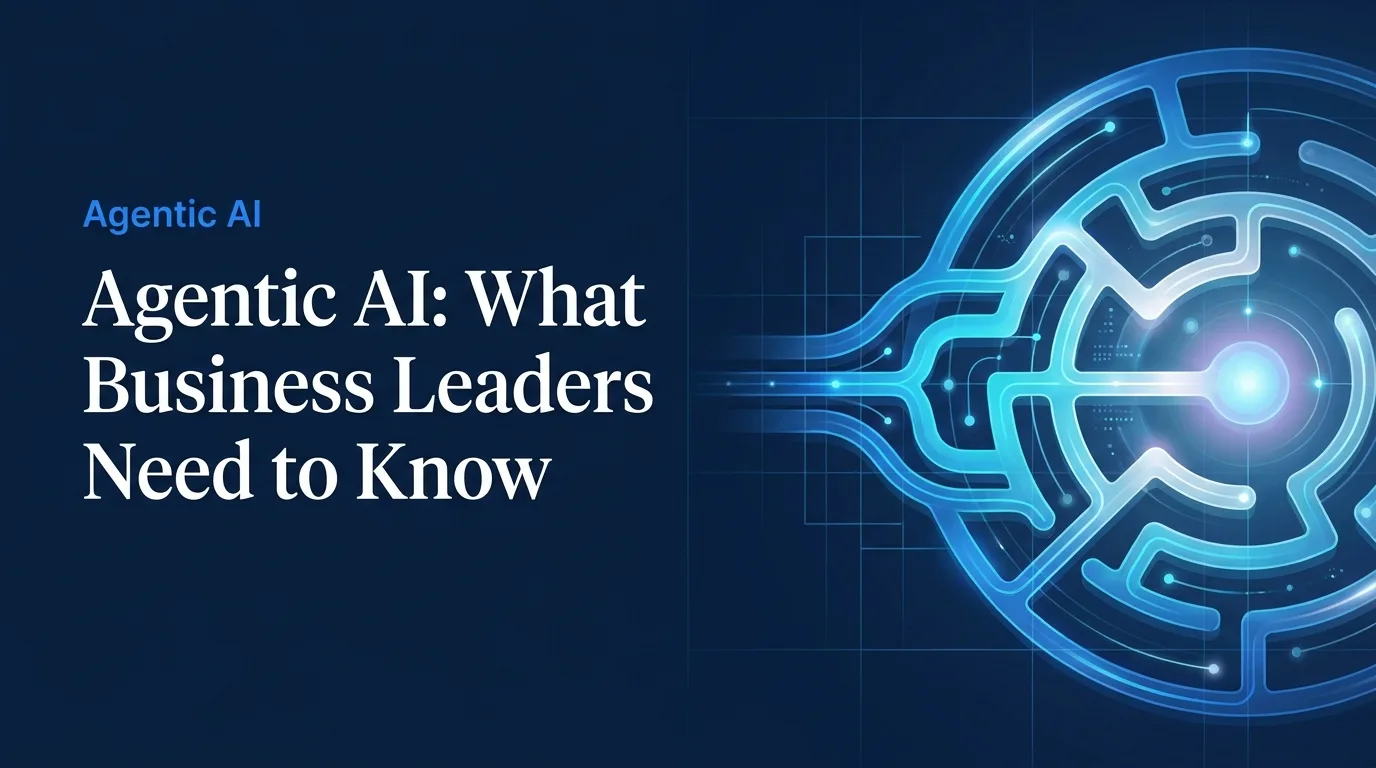
Agentic AI: What Business Leaders Need to Know Before Their Competitors Figure It Out
Every major wave of enterprise technology has a moment when it transitions from experimental to operational. For agentic AI, that moment is now.
Most business leaders understand AI as a tool that answers questions, generates content, or analyzes data when a human asks it to. Agentic AI is categorically different. It does not wait for questions. It plans, acts, and iterates toward goals, using tools, accessing systems, making decisions, and completing multi-step tasks autonomously.
The organizations that understand this shift in the next 12 months will have a window to build capability before it becomes table stakes.
What Makes AI "Agentic"
The word "agent" has a specific technical meaning in this context. An AI agent has four properties that a standard AI assistant lacks:
1. Goal-directedness: The agent receives an objective, not a prompt. "Reduce customer churn in the SMB segment this quarter" is an objective. The agent breaks this into subgoals, identifies what actions are available, sequences those actions, and evaluates whether they are working.
2. Tool use: Agents can call external tools, including APIs, databases, web browsers, file systems, calendars, and communication platforms. They are not limited to what the model knows; they can access and update real-world systems.
3. Memory: Agents maintain context across interactions and over time. They can remember what they have tried, what worked, what the current state of a task is, and what they need to do next.
4. Autonomy: Agents operate without requiring a human prompt for each step. A human defines the goal and sets guardrails; the agent executes the steps required to reach the goal within those guardrails.
What This Means Operationally
The shift from AI assistant to AI agent changes the operational model of virtually every knowledge-work process.
Before agentic AI: A human researches a topic, synthesizes findings, drafts a document, reviews it, sends it.
After agentic AI: A human defines what needs to be produced and the quality criteria. An agent researches, synthesizes, drafts, checks against criteria, iterates, and delivers a ready-to-review output.
The human's role shifts from execution to direction and review. The leverage ratio, measured as valuable output per human hour, expands significantly.
Examples already in production:
- Sales prospecting agents: Research target accounts, identify decision-makers, draft personalized outreach, sequence follow-ups, log interactions to CRM, and surface buying signals with minimal human input beyond approval workflows.
- Customer service resolution agents: Handle end-to-end service requests including account lookups, policy application, refund processing, and follow-up, escalating only genuinely novel or high-stakes situations.
- Financial analysis agents: Pull data from multiple systems, run defined analyses, generate variance explanations, flag anomalies, and produce board-ready summary packages on a scheduled basis.
- Procurement agents: Monitor supplier performance metrics, flag covenant breaches, generate renewal recommendations, prepare RFP packages, and route for approval.
The Governance Imperative
Agentic AI introduces governance challenges that do not exist with AI assistants. When an agent acts autonomously, sending emails, updating records, processing transactions, the risk surface is fundamentally different from an AI that answers questions.
Three governance principles for agentic AI deployment:
1. Define hard limits before deployment, not after. Every agent should have explicit constraints on what it can and cannot do without human approval. These are not suggestions; they are code-level restrictions. An agent that can send emails should have a daily limit and a prohibited recipient list. An agent that can execute transactions should have a ceiling and a category restriction.
2. Build approval workflows into the agent architecture. High-consequence actions (communications to customers, financial transactions, system modifications) should route through a human checkpoint before execution. The agent prepares; the human approves. This is risk management that makes the system trustworthy enough to expand.
3. Log everything. Every action an agent takes, every tool it calls, every decision it makes should be logged with a timestamp, reasoning trace, and outcome. This is not just for audit purposes. It is the training data for improving the agent and the evidence base for expanding its autonomy over time.
Where to Start
Organizations that are AI-ready (with data infrastructure, some production AI experience, and basic governance frameworks) should identify one agentic use case in the next 6 months.
The selection criteria for a first agentic use case:
- High-frequency, well-defined process (volume justifies the investment)
- Low consequence per individual action (mistakes are recoverable)
- Clear success metric (the agent can tell whether it succeeded)
- Existing data and system access (integration work is bounded)
Good first candidates: email triage and routing, meeting scheduling and preparation, data enrichment and CRM maintenance, report generation and distribution.
Poor first candidates: customer communication, financial transactions, hiring decisions, compliance-sensitive operations.
The Competitive Window
Agentic AI capability compounds differently from point AI tools. Organizations that deploy agents learn how to design, govern, and improve them, building organizational capability that accelerates future deployments. Organizations that wait will face both a technology gap and a capability gap.
The window to build this capability advantage is 12-18 months. After that, it becomes table stakes.
The AI Implementation Playbook covers the phased AI deployment framework. For organizations ready to move to agentic deployment specifically, the AI Governance Compliance Guide is the right starting point for the oversight framework.
Was this article helpful?

About Eric Garza
With a distinguished career spanning over 30 years in technology consulting, Eric Garza is a senior AI strategist at AIConexio. They specialize in helping businesses implement practical AI solutions that drive measurable results.
Eric Garza has a proven track record of success in delivering innovative solutions that enhance operational efficiency and drive growth.